
Introduction
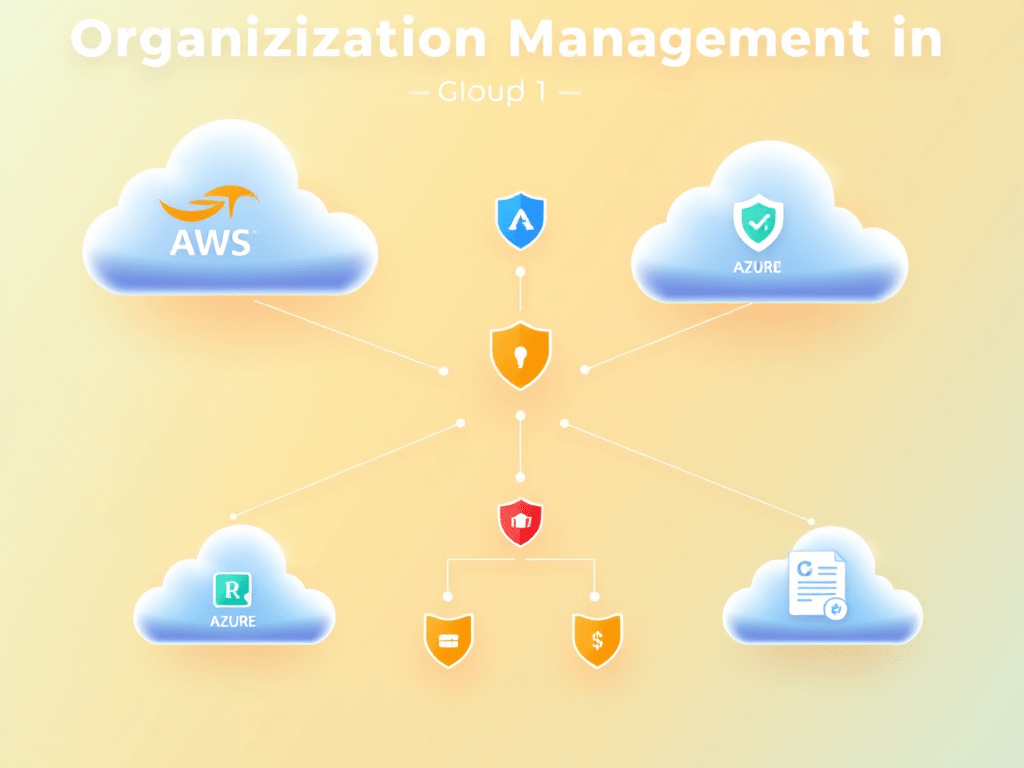
- Purpose: Manage and secure the entire cloud footprint (multi-cloud, hybrid, and SaaS).
- Cloud sprawl (growth through mergers, acquisitions, etc.) creates management complexity.
- Goals:
- Manage organization-level security.
- Use hierarchy for structured deployment control.
- Understand hybrid & multi-cloud management.
Organization Hierarchy Models
Key Terms:
| Level | AWS | Azure | GCP |
| Organization | Organization | Tenant | Organization |
| Group | Organizational Unit (OU) | Management Group | Folder |
| Deployment | Account | Subscription | Project |
- Organization: Top-level structure in CSP.
- Group: Collection of deployments (logical isolation).
- Deployment: Individual, isolated environment.
Benefits: Segmentation, reduced “blast radius,” logical separation, and compliance alignment.
Key Capabilities in Cloud Hierarchy
All major CSPs offer:
- Groups → Create isolation hierarchy.
- Policies → Define what services or APIs are allowed/blocked.
- Centralized IAM → Federated identity management across deployments.
- Shared Security Services → Central logging, monitoring, and governance.
Landing Zone / Account Factory:
- Automates account setup with pre-configured security, compliance, and governance controls.
- Ensures consistency across multiple deployments.
Building Hierarchies (Three Models)
| Model | Description | Strength |
| Business Unit & App-Based | BU → App → Env | Aligns IAM with org units |
| Environment-Based | Env (Prod, Dev, Test) → BU → App | Simplifies policy mgmt |
| Geography-Based | Region → BU → Env | Meets regional compliance needs |
Hybrid approach often works best — mix based on organization needs.
Organization-Level Security
Goal: Control cloud footprint & maintain acceptable risk without hindering agility.
Identity Management
- Minimize root access.
- Restrict who can create deployments.
- Use landing zones/account factories for consistent setup.
Policy Scopes
- Organization-wide: Affects all deployments (rarely used due to broad scope).
- Group-level: Commonly used; cumulative & restrictive.
- Deployment-level: For specific, fine-grained needs.
Policy Use Cases
- Enable/disable unapproved services.
- Block risky API calls.
- Restrict regions for compliance.
- Enforce IP-based access controls.
Shared Organization Services
Used across deployments for consistency and visibility:
- Centralized IAM → unified access control.
- Centralized Logging → forward telemetry to SIEM or security data lake.
- Threat Detection → detect malicious activities in real time.
- Cost Management → tagging policies for accountability.
- Account Factories → IaC-based automated secure deployment setup.
Hybrid Cloud Management
Definition: Integration of on-prem data centers with public cloud.
Security Goals:
- IAM: A compromised identity can affect both environments.
- Network Security: Prevent misconfigurations & overexposure.
Best Practices:
- Avoid “connection sprawl.”
- Use a central bastion network to manage all hybrid connections.
- Keep security controls distinct for cloud vs. on-prem; don’t normalize.
Multi-Cloud Management
Definition: Use of multiple IaaS/PaaS CSPs (AWS, Azure, GCP).
Challenges: High complexity, different tooling, and greater security overhead.
Strategies:
- Single Provider: Consolidate into one CSP.
- Primary/Secondary: Main provider + limited secondary (for special cases).
- Full Multi-Cloud: Equal support for all CSPs — requires advanced maturity.
Best Practice: Mature security in one CSP before expanding to others.
Container Misconception:
- Containers increase workload portability — NOT infrastructure portability.
- Shared services (DB, queues, etc.) are not easily portable.
Tooling & Staffing for Multi-Cloud
- Each CSP requires dedicated expertise.
- Use Managed Service Providers (MSPs) for support, but accountability stays with CSC.
- Ensure MSP aligns with CSC’s governance and security strategy.
SaaS Management in Hybrid & Multi-Cloud
Challenges:
- Many SaaS vendors with varying security levels.
- Uncontrolled integrations = data exposure.
Best Practices:
- Maintain a SaaS registry (approved vendors & data categories).
- Require justification for duplicates.
- Evaluate SaaS vendors before approval.
- Control integrations & data flows between SaaS apps.
Key Tools:
- Federated Identity Brokers – Centralized access for multiple SaaS apps.
- CASB (Cloud Access Security Broker) – Visibility & enforcement over SaaS use.
- API Gateways – Manage and secure inter-SaaS data flows.
Flashcards: https://quizlet.com/in/1101683851/ccsk-domain-4-flash-cards/?i=4jehw4&x=1qqt
Discover more from Information Security Blogs
Subscribe to get the latest posts sent to your email.
